Temple and cultural immersions.
Not tourism. Pilgrimage, made beautiful.
A yatra moves through two landscapes at once.
The outer one is a temple — its ritual, its hours, its particular way of addressing the divine. But no temple in India stands apart from the land that raised it. The music that fills it, the food cooked in its kitchen, the silk on its deity, the dialect its prayers are sung in and the river it was built beside are all one thing, and to see the temple without them is to see almost nothing.
The inner landscape is the reason anyone walks a sacred route in the first place.
RASA Yatra is designed for both. Each journey is built around the specific genius of its region — what only happens there, what has been practised there for centuries, and what a place understands that nowhere else does. Small groups. Slow days. Guided by people who belong to the tradition rather than describe it, with time built in for reflection rather than photographs.
Ten routes through the sacred geography of India.
The Eternal Yatra
Varanasi · Uttar Pradesh
Where the oldest living city meets the oldest question
No other city on earth has been continuously inhabited this long, and none has arranged itself so completely around a single idea: that to die here is to be released. Mornings begin on the water before the light does, the ghats emerging one by one as the city wakes into prayer. Evenings end at Dashashwamedh, where the Ganga Aarti has been performed nightly for longer than most nations have existed. Between them lies a city that has never separated the sacred from the ordinary — where a silk weaver’s loom, a shehnai lesson and a cremation fire occupy the same narrow lane without contradiction.
Kashi Vishwanath · Dawn on the Ganga · Manikarnika · The Benares gharana · Sarnath, where the Buddha first taught · Banarasi silk, woven by hand
The Path of Rama
Ayodhya · Uttar Pradesh
The kingdom that measured itself by conduct
Where other pilgrimages ask what to worship, Ayodhya asks how to live. This is the landscape of the Ramayana — of exile accepted without protest, of power surrendered, of a ruler judged not by conquest but by restraint. The Saryu still runs past the ghats where Tulsidas set the Ramcharitmanas into the vernacular and gave the epic back to ordinary people. On Deepotsav the river carries hundreds of thousands of lamps, and the entire idea of the place becomes visible at once.
Ram Janmabhoomi · Hanuman Garhi · Evening on the Saryu · The Ramcharitmanas tradition · Ramlila performance · Awadhi kitchens
The Path of Bhakti
Braj · Mathura, Vrindavan, Govardhan, Barsana, Nandgaon
The only theology built on play
Braj is not a place people visit so much as one they are absorbed into. Krishna bhakti here is not solemn: it is music, colour, mischief, longing and an intimacy with the divine that no other tradition quite permits. Widows sing through the night at Vrindavan. Pilgrims walk the twenty-one kilometres around Govardhan barefoot. In Barsana, Radha’s village, the Holi is fought with sticks and laughter. The Yamuna, the groves, the Braj dialect and the temple kitchens all belong to one continuous devotional atmosphere that has not lifted in five hundred years.
Banke Bihari · Govardhan parikrama · Samaj gayan · Nidhivan at dusk · Barsana · Chappan bhog · The Braj bhasha of the villages
The Divine Mother
Bengal · Kolkata, Dakshineswar, Kalighat, Mayapur
Where the intellect knelt to ecstasy
Bengal produced two of the most consequential spiritual lives of the modern age within a few miles of each other — Ramakrishna at Dakshineswar and, through him, Vivekananda at Belur. It also produced Chaitanya’s ecstatic kirtan at Mayapur, the Baul minstrels who sing of the man of the heart, and a city that argues philosophy in coffee houses at midnight. Here the Mother is not an abstraction. She is Kali at Kalighat, terrifying and tender at once, and Bengal has never felt the need to soften her.
Kalighat Shakti Peetha · Dakshineswar · Belur Math · Mayapur kirtan · Baul singers · Bishnupur terracotta · Jorasanko and the Tagore house
Shiva & Shakti
Assam · Kamakhya, Brahmaputra, Majuli
The wild feminine, and a river with a masculine name
Kamakhya is the most unusual of the Shakti Peethas: there is no image in the sanctum, only a cleft in the rock and a spring, and the temple closes each year when the Goddess is said to menstruate. Tantra here is neither exotic nor hidden — it is the ordinary religion of the hill. Below runs the Brahmaputra, braided and enormous, and on it sits Majuli, the largest river island in the world, where the satras founded by Srimanta Sankardeva have preserved a monastic culture of dance, mask-making and devotional theatre for five centuries.
Kamakhya · Umananda on its island · Majuli’s satras · Sattriya dance · Mask-making at Samaguri · Muga silk · The Brahmaputra at dusk
The Himalayan Source
Uttarakhand · Rishikesh, Devprayag, Gangotri
Following a river to the place it stops being a river
This is the only yatra that moves upstream. It begins where the Ganga reaches the plains at Rishikesh and follows her back through Devprayag — the confluence where the Bhagirathi and Alaknanda meet and the Ganga is first called by that name — toward Gangotri and, beyond it, the glacier snout at Gaumukh. The valleys narrow, the temples thin out, the conversation quietens without anyone deciding it should. Purification here is not metaphorical. It is altitude, cold water and the steady removal of things.
Ganga Aarti at Parmarth · The confluence at Devprayag · Gangotri · Neelkanth · Ashram mornings · Deodar forest · Silence above the treeline
The Himalayan Shiva Yatra
Himachal Pradesh · Vashisht, Bijli Mahadev, Manikaran
Where the gods still travel by palanquin
Himachal keeps a form of religion that has largely vanished elsewhere: village deities who own land, settle disputes, refuse invitations and are carried through the mountains on palanquins by their own people. At Bijli Mahadev the lingam is struck by lightning and shattered, then reassembled each time with butter. At Manikaran, boiling springs rise beside a Sikh gurdwara and a Shiva temple, and pilgrims of both cook their food in the same water. The mountains are not a backdrop to the faith here. They are the participants.
Bijli Mahadev · Manikaran springs · Vashisht · Devta culture and the Kullu Dussehra · Parvati valley · Naggar · Cedar and apple orchard
The Jagannath Yatra
Odisha · Puri, Bhubaneswar, Konark
A deity treated as a member of the household
At Puri the Lord is bathed, dressed, fed and put to bed. He falls ill after his bath festival and is nursed in seclusion. Once a year he leaves the temple altogether and is pulled through the streets so that those who may not enter can still see him. The temple kitchen is among the largest in the world, cooking in stacked earthen pots over wood fire, and the resulting Mahaprasad dissolves caste at the point of eating. Along the coast stands Konark — the sun temple built as a colossal stone chariot — and inland, the Odissi tradition that began as temple dance.
Jagannath Temple · The Rath Yatra · Ananda Bazaar and Mahaprasad · Konark · Lingaraj · Odissi · Pattachitra · Pipili applique
The Temple Civilization
Tamil Nadu · Kanchipuram, Chidambaram, Thanjavur, Madurai, Rameswaram
Where the temple was the city, not a building in it
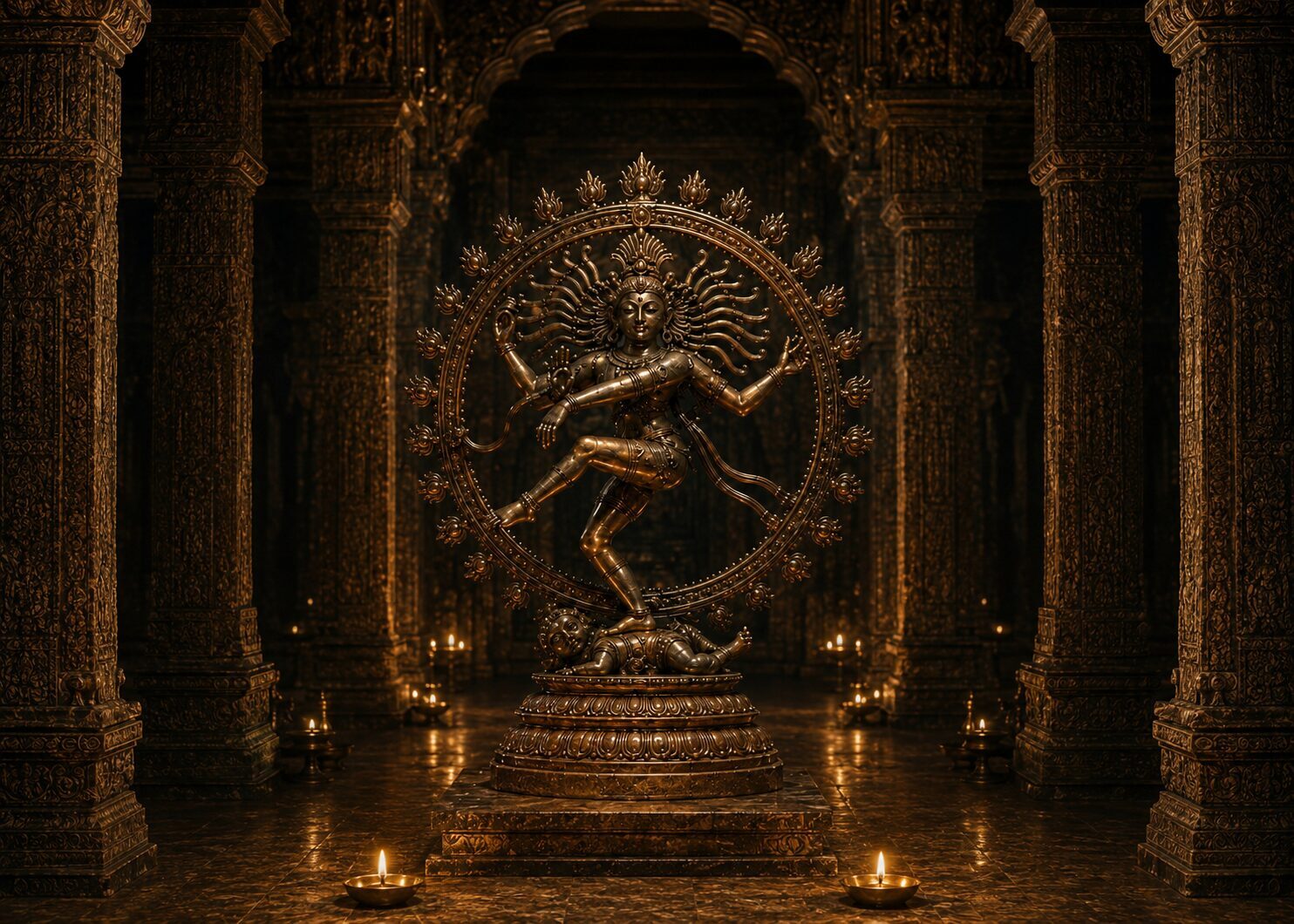
In the Tamil south the temple was treasury, university, granary, concert hall and civic centre at once, and the city arranged itself in concentric streets around it. Chidambaram enshrines Nataraja and, behind a curtain, the Chidambara Rahasya — a sanctum containing nothing at all, space itself as the object of worship. Thanjavur’s Brihadeeswarar has stood a thousand years. At Madurai, Sundareswarar is carried each night to Meenakshi’s chamber and returned each morning. The Chola bronzes, the Carnatic tradition and Bharatanatyam all descend from these walls.
Meenakshi Amman · Chidambaram and the secret of space · Brihadeeswarar · Rameswaram’s corridor and its twenty-two wells · Chola bronze · Carnatic music · Kanchipuram silk
The Sacred Desert
Rajasthan · Pushkar, Ajmer, the Thar
Two faiths, one desert, and music holding both
Pushkar holds the only significant temple to Brahma anywhere, on a lake ringed by fifty-two ghats. Seventeen kilometres away lies the dargah of Moinuddin Chishti at Ajmer, where qawwali is sung nightly and Hindus and Muslims have petitioned side by side for eight centuries. Out in the Thar, the Manganiyar and Langa hereditary musicians play for patrons of the other faith, and the Kalbeliya — the nomadic snake-charming community whose dance UNESCO now protects — turned a lost livelihood into an art form. Nowhere in India is the boundary between traditions more porous, or more beautifully sung.
Brahma Temple and the Pushkar ghats · Qawwali at Ajmer Sharif · Kalbeliya dance · Manganiyar and Langa musicians · Desert nights · Havelis · The camel fair
The difference is who opens the door.
Access, not itinerary
Priests, musicians, weavers, cooks and scholars who have inherited their practice rather than studied it. Hours chosen for the ritual rather than the coach.
Comfort held quietly
Heritage properties, palace hotels and the best rooms available in places that were never built for visitors. Comfort arranged so completely that it stops being noticed.
Room to be affected
Meditation and reflection built into each day, and long stretches with nothing scheduled at all. A yatra that only fills the hours has missed its purpose.
A yatra brings guests to a region, not a room.
Each journey moves through several places, which makes partner properties along a route part of the itinerary rather than the whole of it. For a heritage hotel in Varanasi, Puri, Madurai or Pushkar, a recurring yatra is a source of high-value guests in months that are otherwise quiet — and it asks nothing of the property’s wellness facilities.